
In-House Compounding and Filling: Mistakes Brands Make When Assessing It
Compounding and filling are separate processes with separate quality systems, and a supplier that does one well does not automatically do the other. The most common assessment mistake is to accept a single assurance — we do everything in house — without establishing which operations are genuinely under the supplier's own roof and which are coordinated by the supplier but performed elsewhere. The difference shows up in traceability, in change control and in how quickly a problem can be found.
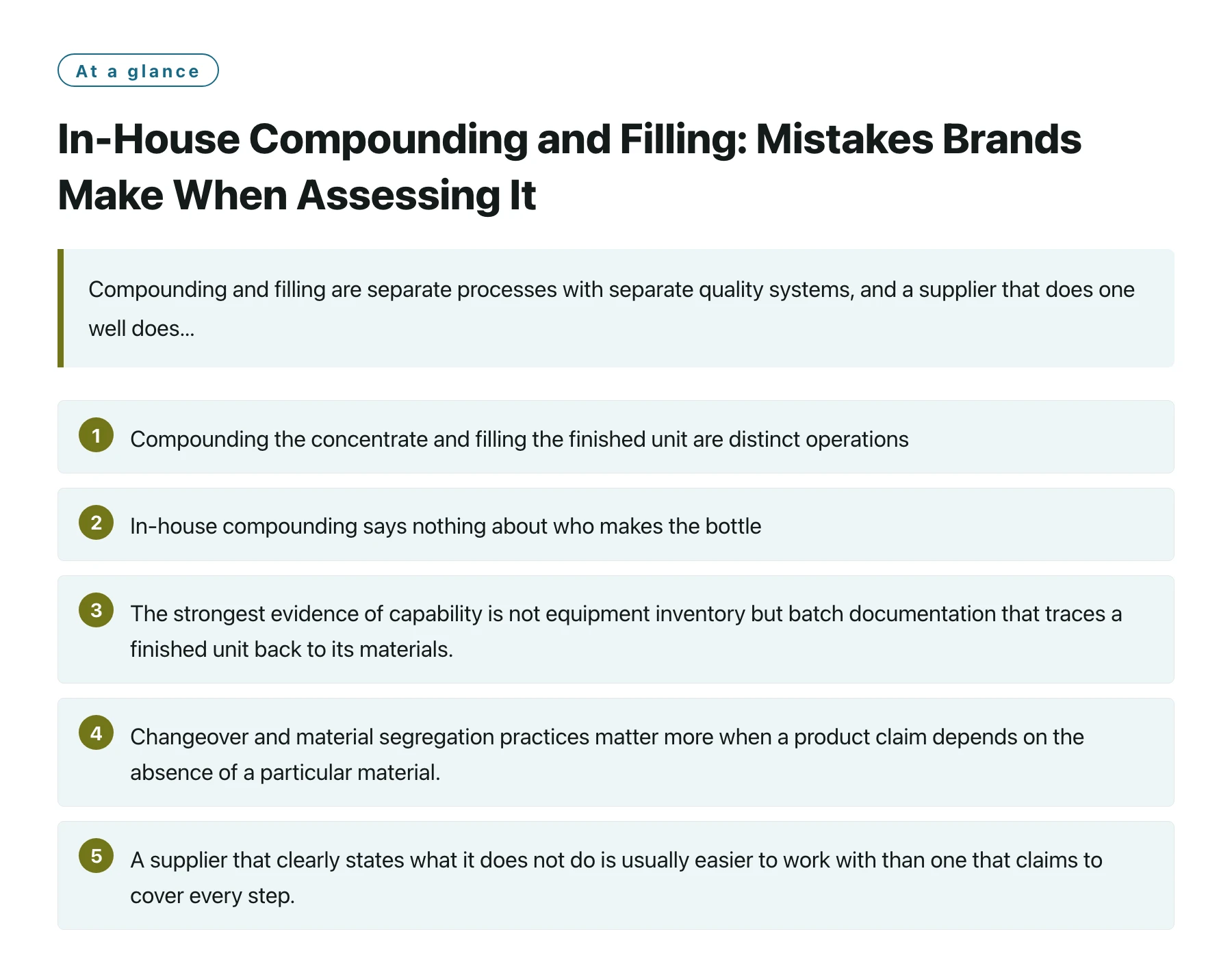
Key takeaways
- Compounding the concentrate and filling the finished unit are distinct operations, each with its own equipment, records and failure modes.
- In-house compounding says nothing about who makes the bottle, the pump or the refill vessel, and vice versa.
- The strongest evidence of capability is not equipment inventory but batch documentation that traces a finished unit back to its materials.
- Changeover and material segregation practices matter more when a product claim depends on the absence of a particular material.
- A supplier that clearly states what it does not do is usually easier to work with than one that claims to cover every step.
Capability conversations tend to collapse several operations into one word. A brand asks whether the factory does everything in house, hears yes, and proceeds as though that settled the compounding, the filling, the pack and the documentation. Each of those is a separate question with a separate answer.
This article sets out the assessment mistakes that follow from that collapse, and the specific questions that restore the missing detail. It is written for a brand with a claim to protect, where the trail from material to finished unit has to be demonstrable rather than assumed.
Four mistakes that distort the assessment
Reading one assurance as four capabilities
A supplier may weigh and blend materials, hold stock, fill and assemble, and still buy its bottles from a specialist, its pumps from another and its refill closures from a third. None of that is a defect; specialised component supply is normal. The mistake is to assume that a single in-house statement covers compounding, filling, components and decoration, when it may cover only the middle of that chain.
The corrective question is simple and specific: for each operation, is it performed on your site, and if not, who performs it and under whose quality system? Documented answers to that question are what make the rest of the assessment meaningful.
Assessing filling by volume rather than by product
Filling equipment is matched to a product, not to a category. A line that handles a viscous cream is not the line that accurately doses an alcohol-based concentrate into a small refill vessel, and a line that fills a hundred millilitre bottle is not necessarily suited to a ten millilitre travel format. Capacity statements expressed in units per day say very little without the pack format attached to them.
The practical test is to ask what the smallest and the most awkward format the line currently runs is, and what changes were needed to run it. Answers about tooling, changeover time and reject rates at that size reveal the real capability more reliably than a throughput figure.
Ignoring how material reaches the line
If the concentrate is compounded at one site and filled at another, there is a transfer step with its own risks: storage conditions, container compatibility, and the possibility that the formula rests for an unintended period before filling. None of these are fatal, but they have to be documented, because they affect both the retained reference sample and the shelf-life estimate.
Transporting a concentrate also creates an interface between two quality systems, and interfaces are where records tend to be thinnest. Ask which organisation signs the release of the concentrate and which signs the release of the finished unit; a scent development and manufacturing partner should be able to answer for both without referring the question elsewhere.
Judging the factory by its equipment photographs
Equipment is visible; process discipline is not. A batch record, a deviation log, a changeover procedure and a retained sample register are better evidence of capability than a gallery of machinery, because they show what happens when something departs from plan. A supplier that can walk a buyer through a deviation, from detection to disposition, is demonstrating the system rather than the showroom.
This matters especially where a product claim depends on the absence of a material. Segregation and cleaning between runs have to be evidenced, not promised, and the evidence lives in the same documentation set.
What common capability statements cover, and what they leave open
| Statement | What it normally covers | What it leaves open |
|---|---|---|
| We compound in house | Weighing, blending and holding of the concentrate on the supplier's own site | Where the concentrate is filled, and who owns the release of each stage |
| We fill in house | Dosing, crimping or capping and assembly of the finished unit | Whether components were qualified by the supplier or supplied as brand-furnished items |
| We handle packaging | Sourcing or coordination of bottle, closure and carton | Which components are made on site and which are bought to a specification |
| We are certified | The management system audited, within the scope of the certificate | Whether the specific product and format fall inside that scope |
| We work with international standards | Adherence to published material limits for the product category | Which version of the standards applies and who checks each incoming material |
Rewrite each statement from your last supplier conversation as a question. The scope of the answer is usually narrower than the scope of the statement.
The standards layer that sits underneath all of it
Fragrance materials are governed by published standards that set limits per material and per product category, so a capability claim is only complete if it says who checks conformance and against which version of the standards [1]. For a brand with a claim to defend, that check is the difference between documentation and assertion.
Safety limits themselves are set with reference to independent scientific assessment, and the opinions behind those limits are public [2]. A supplier that can name the assessment behind a restriction, rather than only the restriction, tends to have a more robust internal review, because it understands why a limit moved.
For a vegan-positioned brand, the practical consequence is narrow but real. The formula has to be confirmable at material level, and the changeover practice that keeps one run distinct from the next has to be documented. Neither requirement is unusual, and neither is a reason to avoid a supplier; they simply have to be asked about before the order rather than after the claim is printed on the carton.
When a supplier runs compounding and filling under one roof, this whole layer is easier to verify, because one organisation holds the formula, the batch record and the pack specification, and it can answer for the chain rather than for one link of it.
The useful way to end an assessment is to ask for the scope in writing, stage by stage. Xuelei fragrance OEM/ODM is one example of how such a scope is published, and a a manufacturer that supports OEM and ODM should be able to describe in the same breath what it does not do. That answer is more informative than any assurance that everything is handled in house.
For each operation, ask three things: where it happens, who signs the release, and what the record looks like. Capability that cannot answer all three is coordination, not control.
Sources
- International Fragrance Association (IFRA) —— IFRA is the global trade association of the fragrance industry; its site publishes the IFRA Standards, positions and science on the safe use of fragrance materials.
- EU Scientific Committee on Consumer Safety (SCCS) —— The EU scientific committee that issues opinions on the safety of cosmetic ingredients, including fragrance allergens and their labelling thresholds.
Frequently asked questions
Does in-house compounding mean the whole product is made on one site?
No. It usually refers to the concentrate. Bottles, pumps, closures and cartons are frequently bought from specialists, and those components have their own quality arrangements.
How can I verify filling capability without visiting the factory?
Ask for the smallest and most difficult format the line currently runs, the changeover procedure and the reject rate at that format. Then ask for the batch record structure for a recent run.
Why does the transfer of concentrate between sites matter?
It introduces storage and compatibility risks and creates an interface between two quality systems. It also affects the retained reference sample used to judge later batches.
What should a vegan-positioned brand ask about specifically?
Material-level confirmation for the formula, and the documented changeover and segregation practice between runs. The claim rests on the absence of a material, so the evidence has to come from the process record.
Is it a problem if a supplier outsources part of the work?
Not by itself. Specialised supply is normal. It becomes a problem when the arrangement is not disclosed, because the brand cannot then verify traceability or change control.
Packaging that sells and a brand built to scale.
Book a 30-minute discovery call with the InLeaf Design studio. FSC substrates, compostable specs, retail-ready artwork — shipped in seven weeks.
Start Your Brand Sprint